Built to Last, Part 2:
Eight flows, one Klaviyo account, and a lot of "set it and forget it"
How the St. James Jewellers automations were mapped — and why ready-made flows are the quiet hero of ecommerce email
A quick note before we start: St. James Jewellers & Co. is a fictional brand created purely for illustration — the name, branding, and products are entirely invented, and any resemblance to a real jeweller, living or trading, is coincidental. This series is an educational and illustrative exercise, not financial or business advice. The figures discussed later in the series are directional benchmarks rather than guarantees.
The stat that changes how you think about flows
Here's a number worth sitting with: Klaviyo's own benchmarking puts automated flow revenue at roughly 30x that of one-off campaigns per recipient. Not 30% more — thirty times.
That gap exists because flows are triggered by behaviour, sent at the moment of highest relevance, and — critically — they run whether or not anyone on the marketing team is awake, on shift, or remembered to hit send. A campaign is a single event. A flow is infrastructure. Build it once, and it earns quietly in the background for as long as the brand exists.
The map: eight flows, six stages
The full customer journey [see the unified Customer Journey diagram] runs across six stages — Discovery, Consideration, Purchase, Fulfilment, Post-delivery, and Long-term relationship — and the eight flows slot into specific points along that path:
Flow 1 — Welcome series. Three emails, triggered on sign-up. Sets tone, captures preferences, makes the welcome offer.
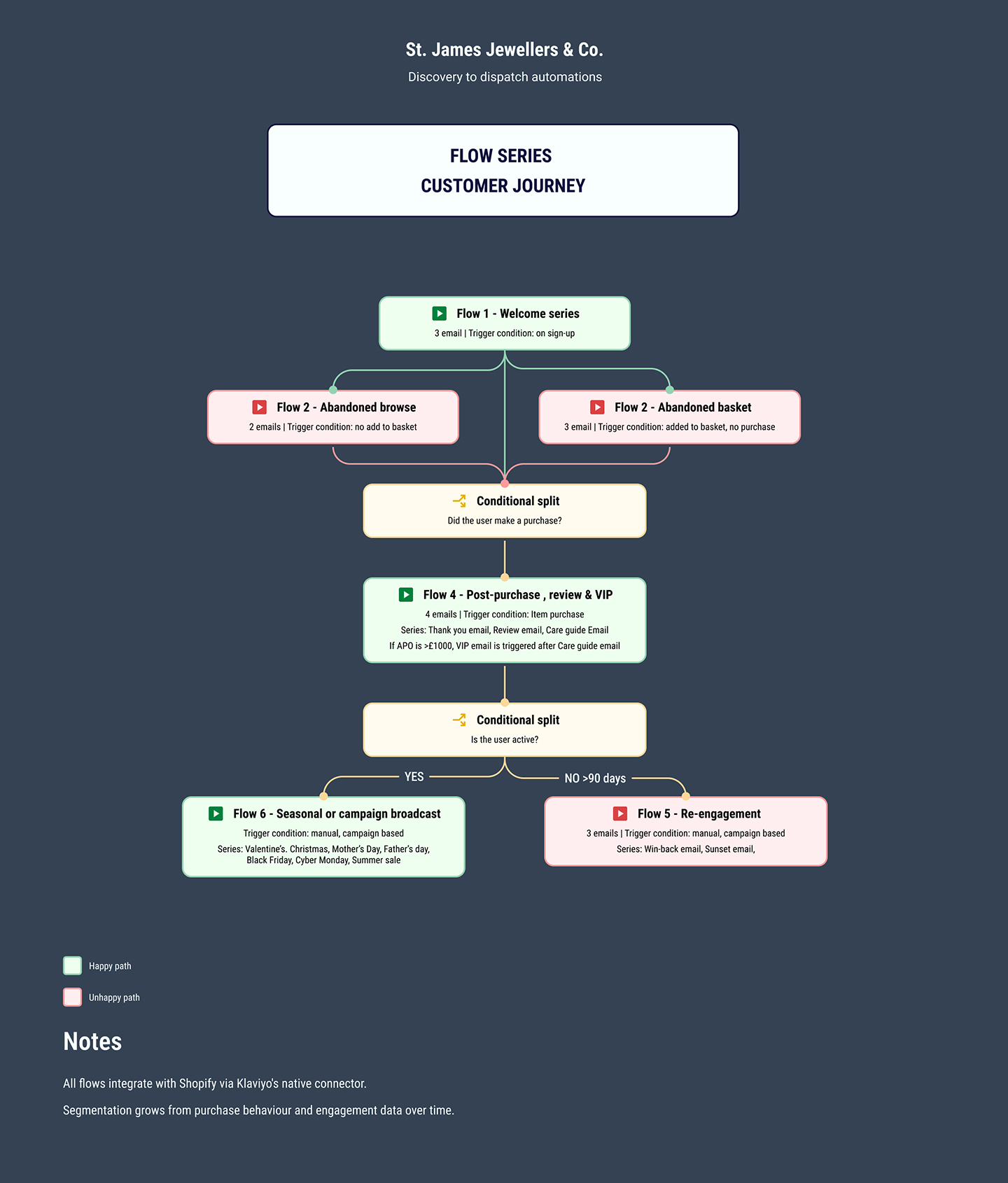
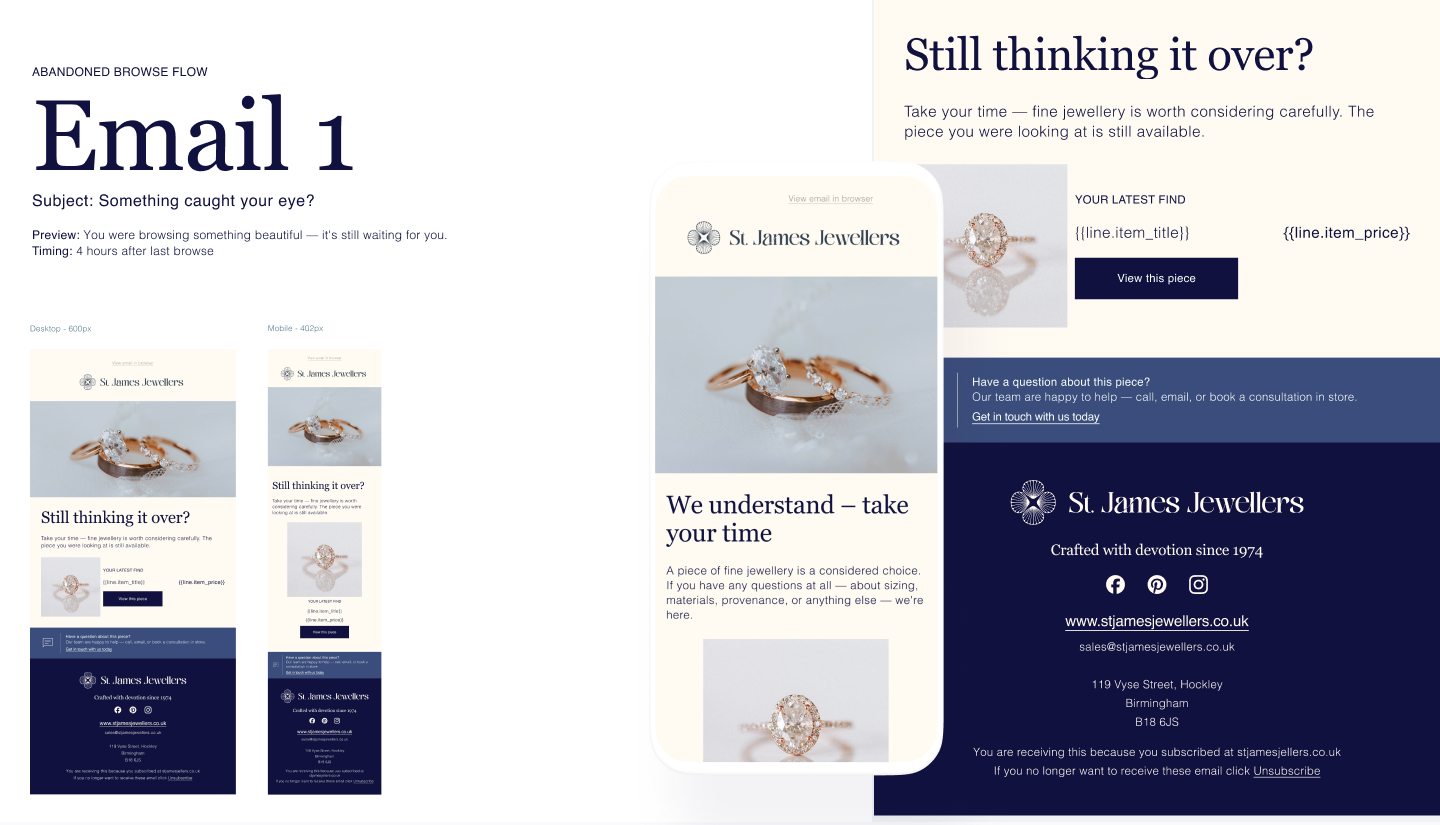
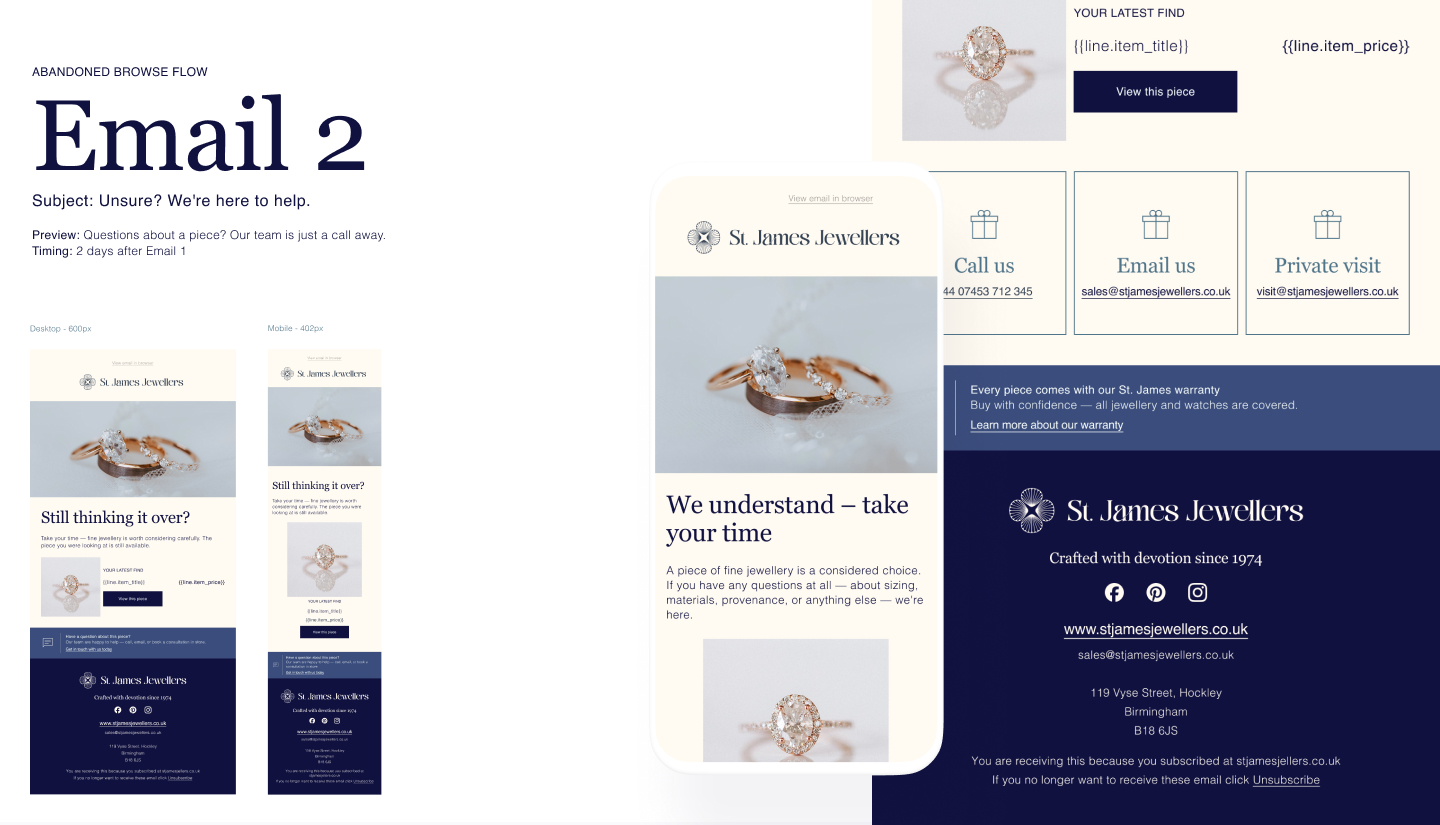
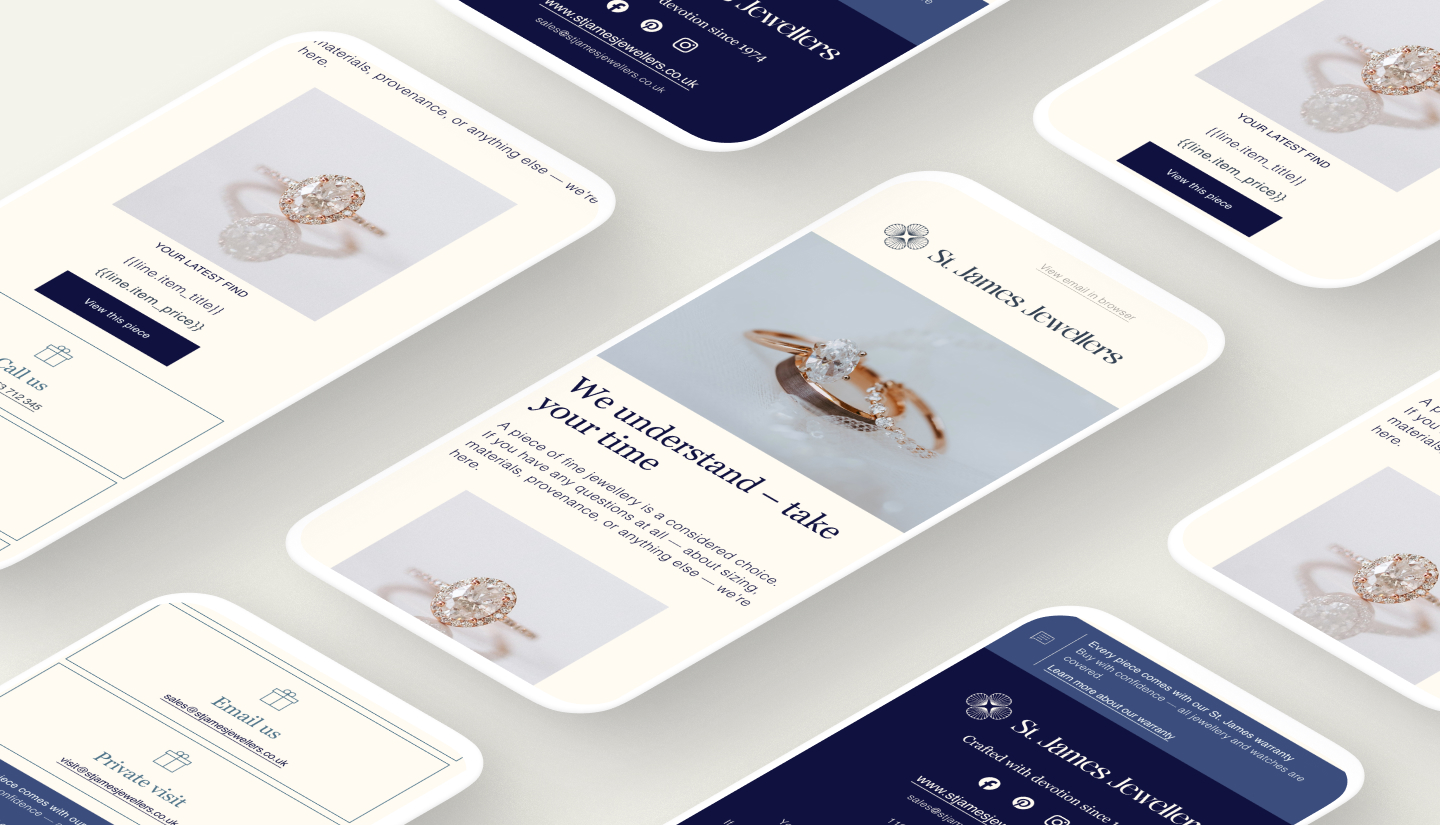
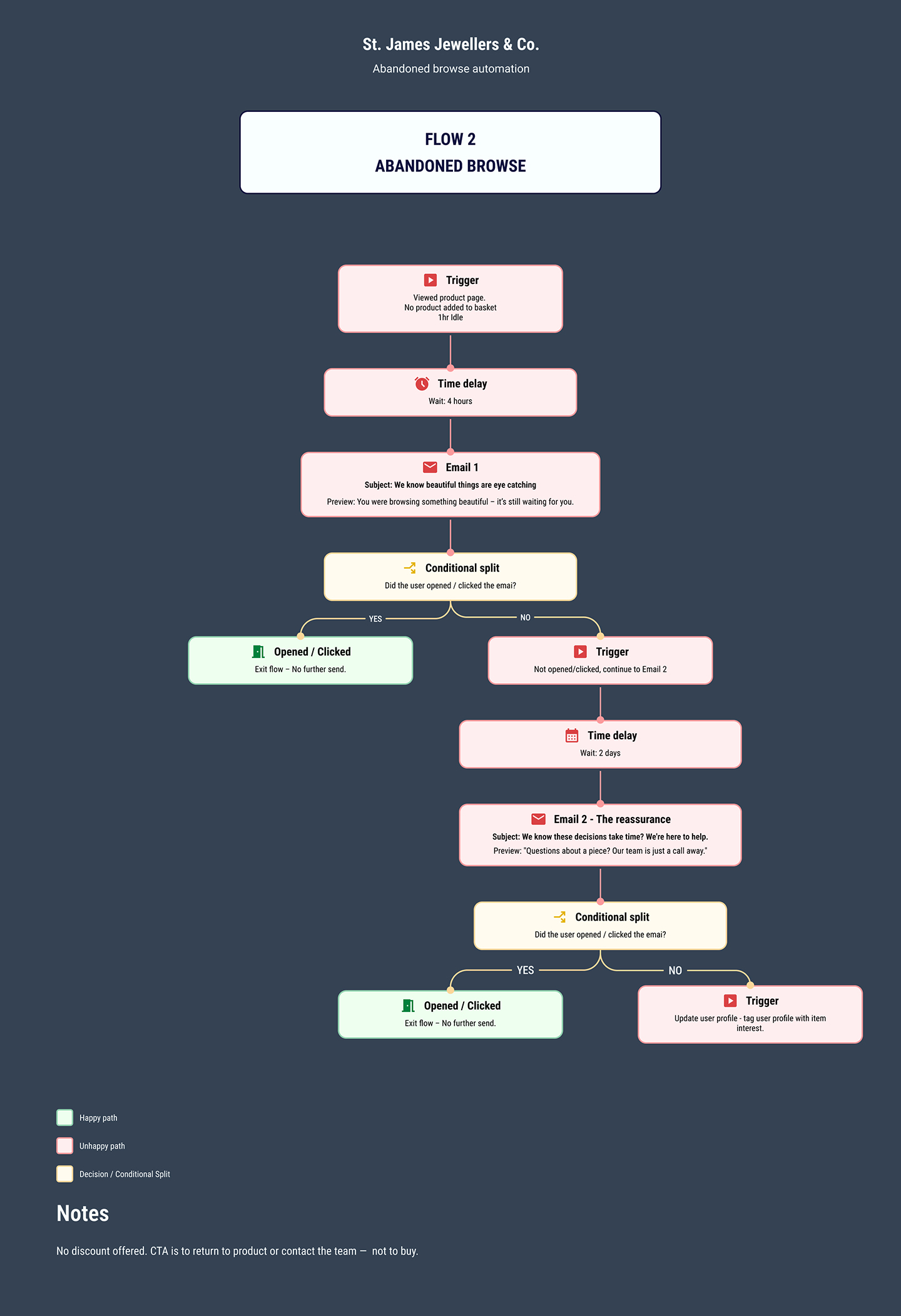
Flow 2 — Abandoned browse. Two emails for someone who viewed a product but didn't add to basket. No discount — the second email simply offers a human conversation ("Unsure? We're here to help").
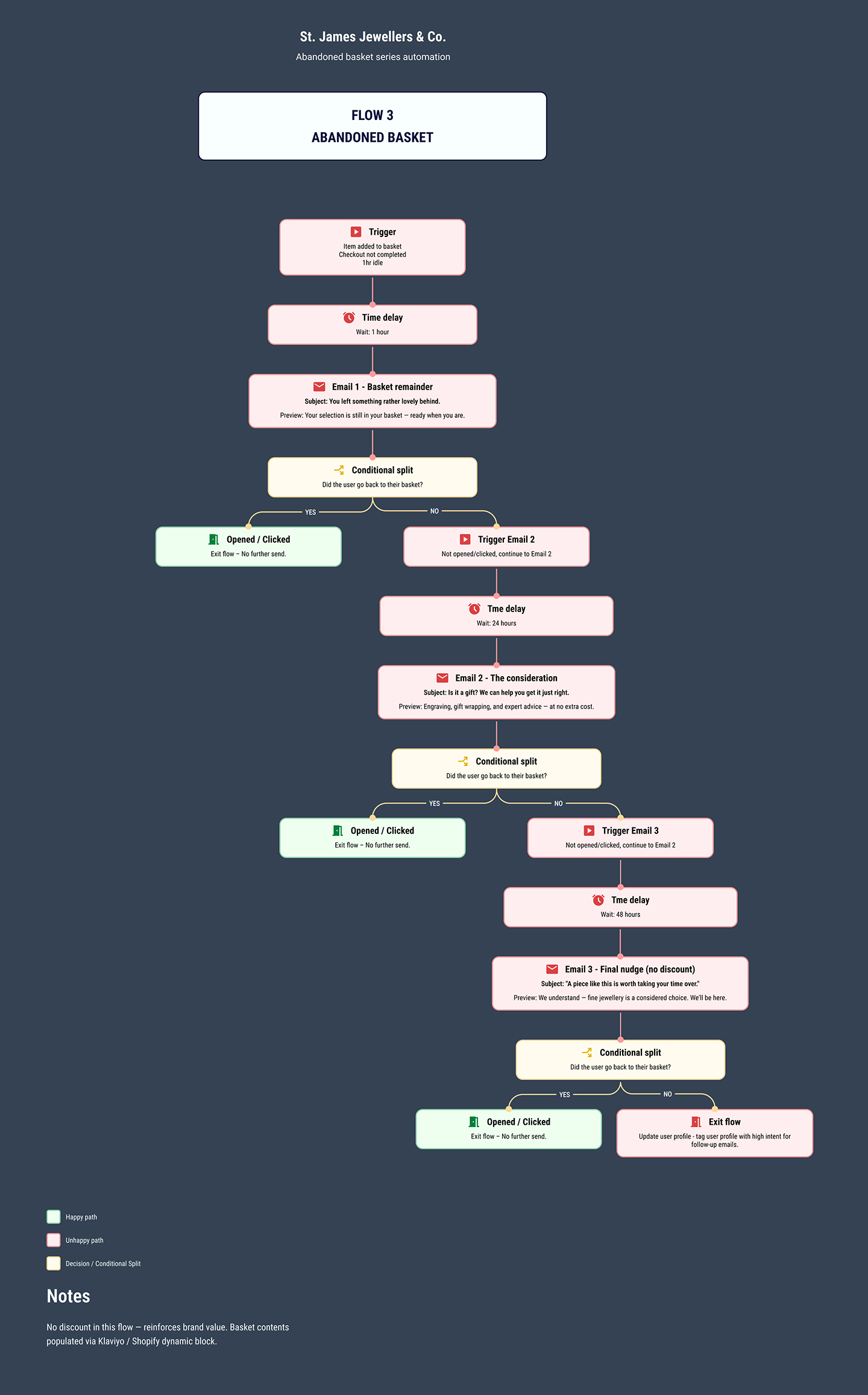
Flow 3 — Abandoned basket. Three emails, escalating from a simple reminder to a gifting-services reframe to a final "no rush, we mean it" message. Customers who view 3+ products without buying get flagged for the team to follow up personally — a nice example of automation knowing when not to automate.
Flow 4 — Post-purchase, review & VIP. Four emails covering dispatch, a category-specific care guide (jewellery vs. watch — more on this dynamic content in Part 3), a review request, and — conditionally — an invitation to the St. James Circle VIP programme for second-time buyers or anyone with an order over £1,000.

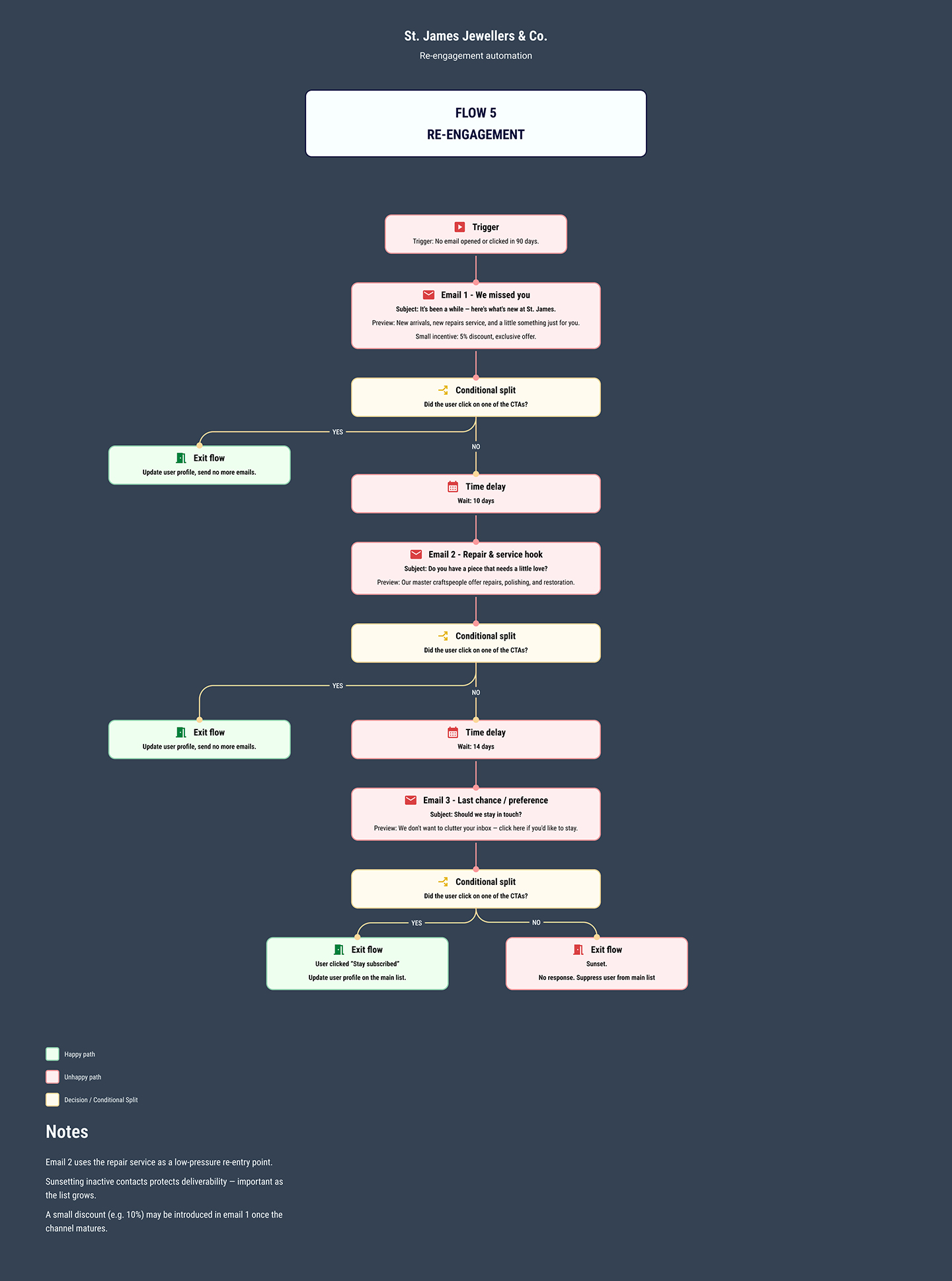
Flow 5 — Re-engagement. Three emails for subscribers who've gone quiet for 90 days. The middle email leads with the repair service as a low-pressure way back in. The last email asks, plainly, "should we stay in touch?" — and if there's no response, the contact is sunset from the list entirely.
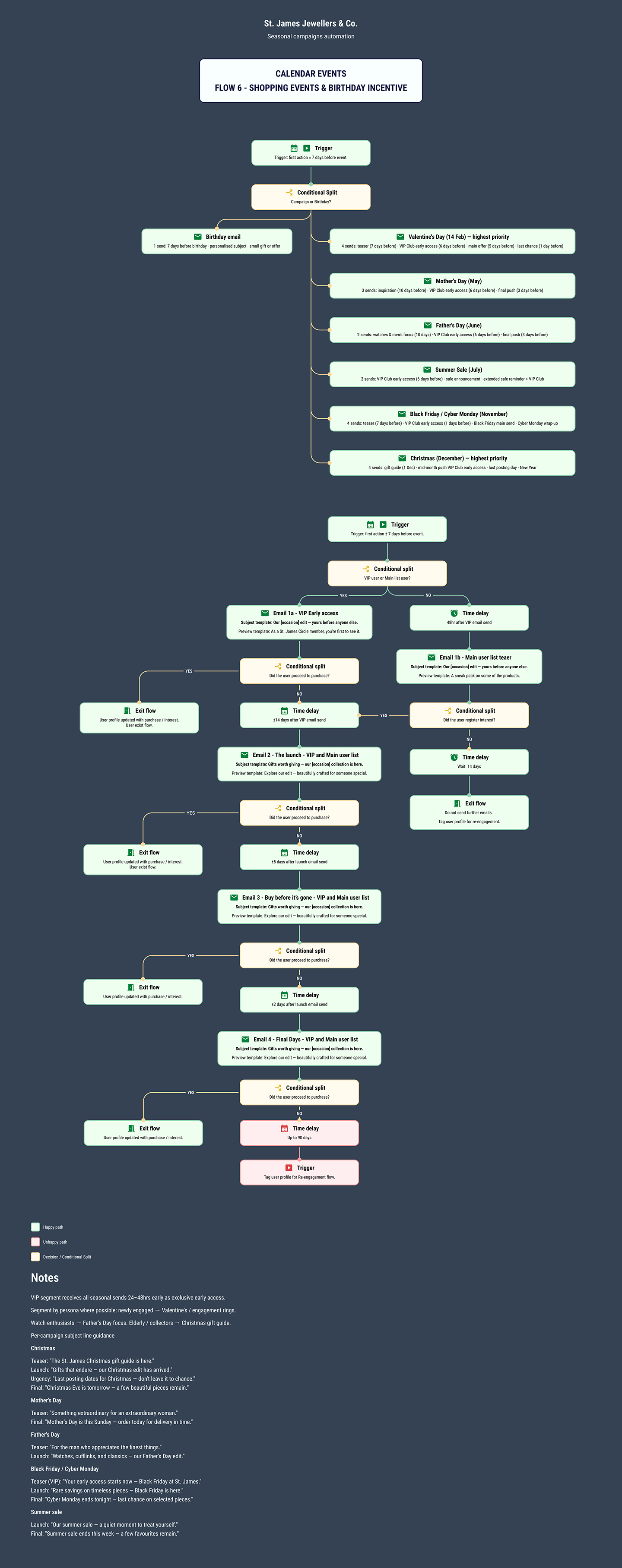
Flow 6 — Seasonal campaigns. Not one flow but a flexible template covering Valentine's Day, Christmas, Mother's and Father's Day, Black Friday/Cyber Monday, summer sale, and birthdays — each adapted from a shared structure.
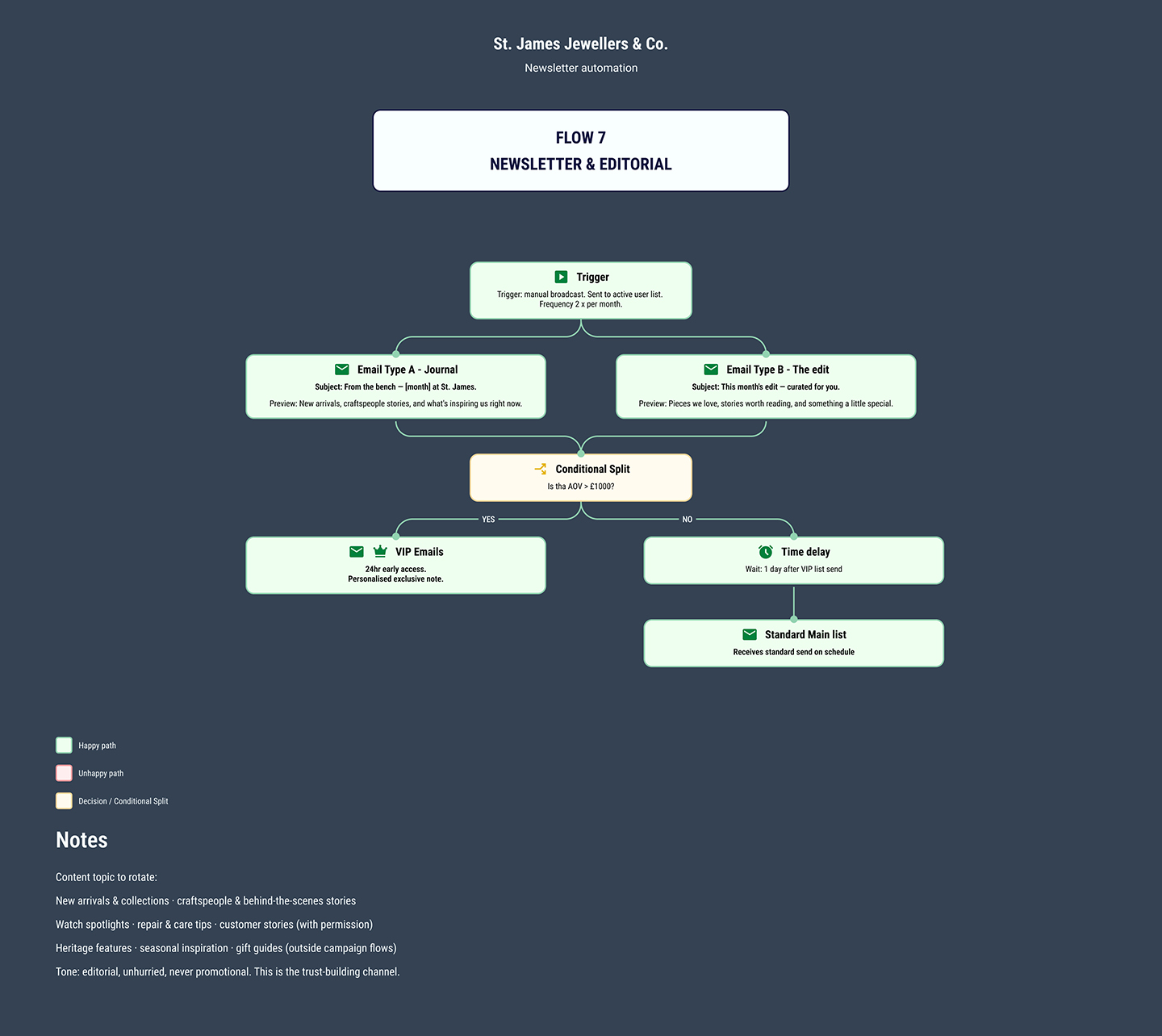
Flow 7 — Newsletter & editorial. Twice-monthly, alternating between "The Journal" (heritage storytelling) and "The Edit" (curated picks). VIP segment gets 24 hours early.
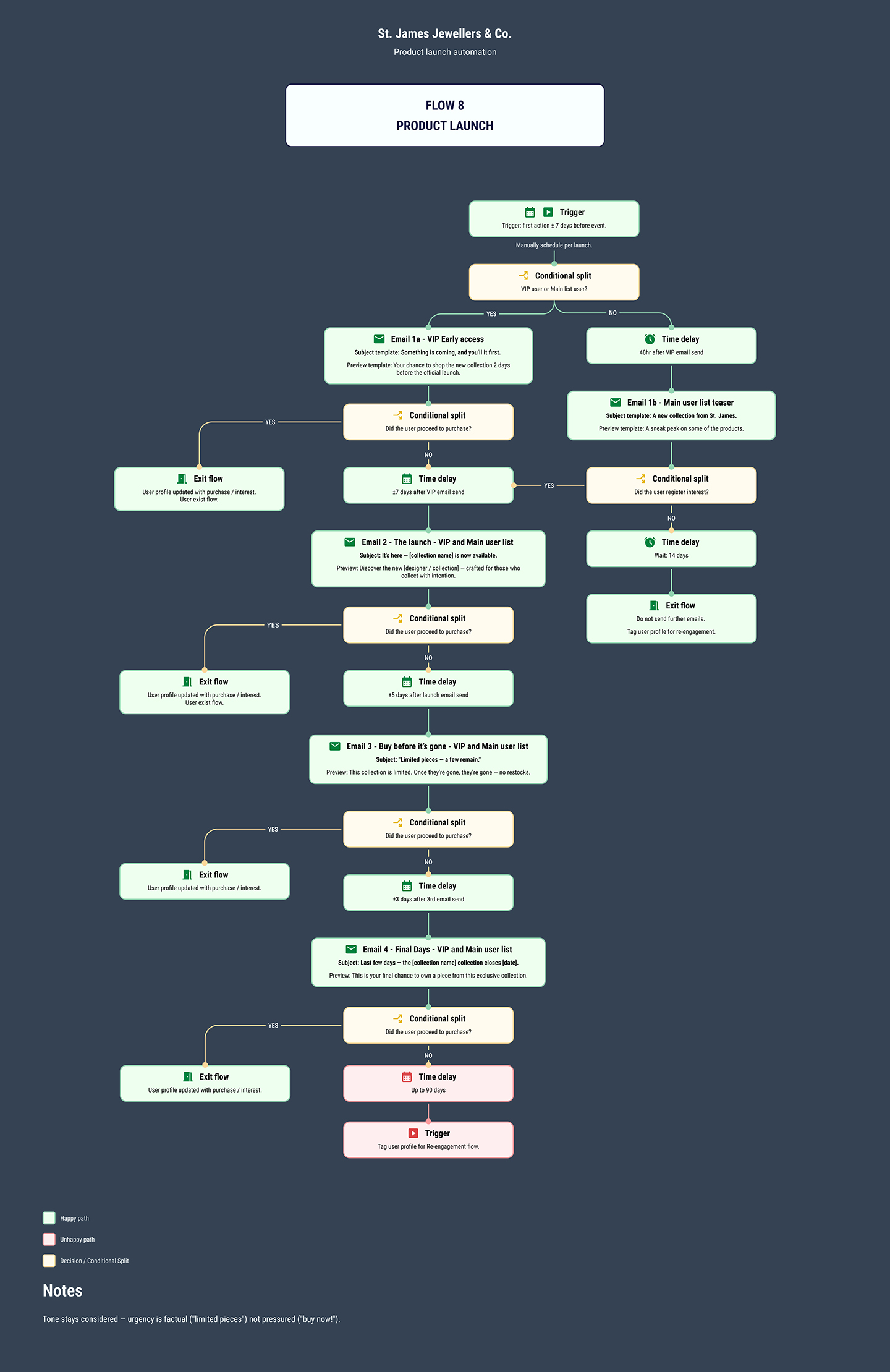
Flow 8 — Product launch. A four-email reusable template for any limited collection — VIP early access, full launch, "buy before it's gone," and final days.
Why "ready-made" doesn't mean "generic"
There's a common worry with automated flows: that they feel robotic, or that personalisation gets sacrificed for scale. The St. James flows are a good counterexample. Nearly every flow includes conditional splits — did the user open, click, use the promo code, return to their basket, proceed to purchase?
Take the welcome series: after each email, Klaviyo checks whether the recipient used their promo code. If yes, they're segmented by preference and exit the flow. If not, they get a time delay and the next email. That's three decision points across three emails — built once, running automatically for every new subscriber, forever.
The re-engagement flow does something similar for list hygiene: anyone who clicks at any point exits immediately (no further unnecessary sends), while anyone who remains silent through all three emails receives a respectful final "would you like to stay subscribed?" before being sunset. That single flow protects deliverability for the entire account — a benefit that's invisible until you consider what happens without it (a list full of disengaged contacts that gradually drags down everyone's inbox placement).
The advantage nobody talks about: maintenance is nearly zero
Once these eight flows are live, the brand’s day-to-day workload will be genuinely light. Seasonal campaigns need new images and dates each year. The newsletter needs fresh content twice a month. Everything else — welcome, abandonment, post-purchase, re-engagement — runs untouched, automatically picking up every new subscriber, every abandoned basket, every dispatched order.
For a small team (or a single in-house marketer), that's the difference between "email marketing" being a daily task and being infrastructure that simply exists.
The takeaway
Flows aren't just "automated campaigns" — they're closer to plumbing. Once they're mapped and built correctly, with the right conditional logic at each step, they keep working without anyone needing to remember they exist. For a brand like St. James, where every flow had to match a very specific tone (no urgency, no discount-first thinking), getting that logic right up front meant the ongoing effort dropped to almost nothing.
In Part 3, we'll get into the emails themselves — the design system, the UX thinking, and why a jewellery brand's emails should look more like a lookbook than a leaflet.